It’s always the surprises that make travel unforgettable. You plan, you read the “must-see” lists, you bookmark museums—and then something unexpected swoops in and steals the show. That’s exactly what happened to me in Stockholm.
After ticking off the Nationalmuseum, Moderna Museet, and Fotografiska (all amazing, by the way), I was craving something a little more unusual—something artsy, but with its own twist. That’s when I stumbled upon Stockholm’s metro system and its underground art.
Turns out, Stockholm’s metro is more than just a way to get around—it’s a full-on art journey. One hundred stations, and each one tells a different story. Some are quiet and introspective, others bold and theatrical. Since 1957, artists have been involved in shaping the stations as they were built, and even the older, less glamorous ones have been lovingly revamped with sculptures, murals, and installations.
Spending a day hopping from platform to platform felt like following a visual story across time—from the mid-century visionaries of the ’50s to the radical experimenters of the ’70s and beyond.
Managed to see around 15 stations but here’s a slice of what I saw and loved the most:
T-Centralen
Opened: 1957 (second part: 1975)
Artist: Per Olof Ultvedt
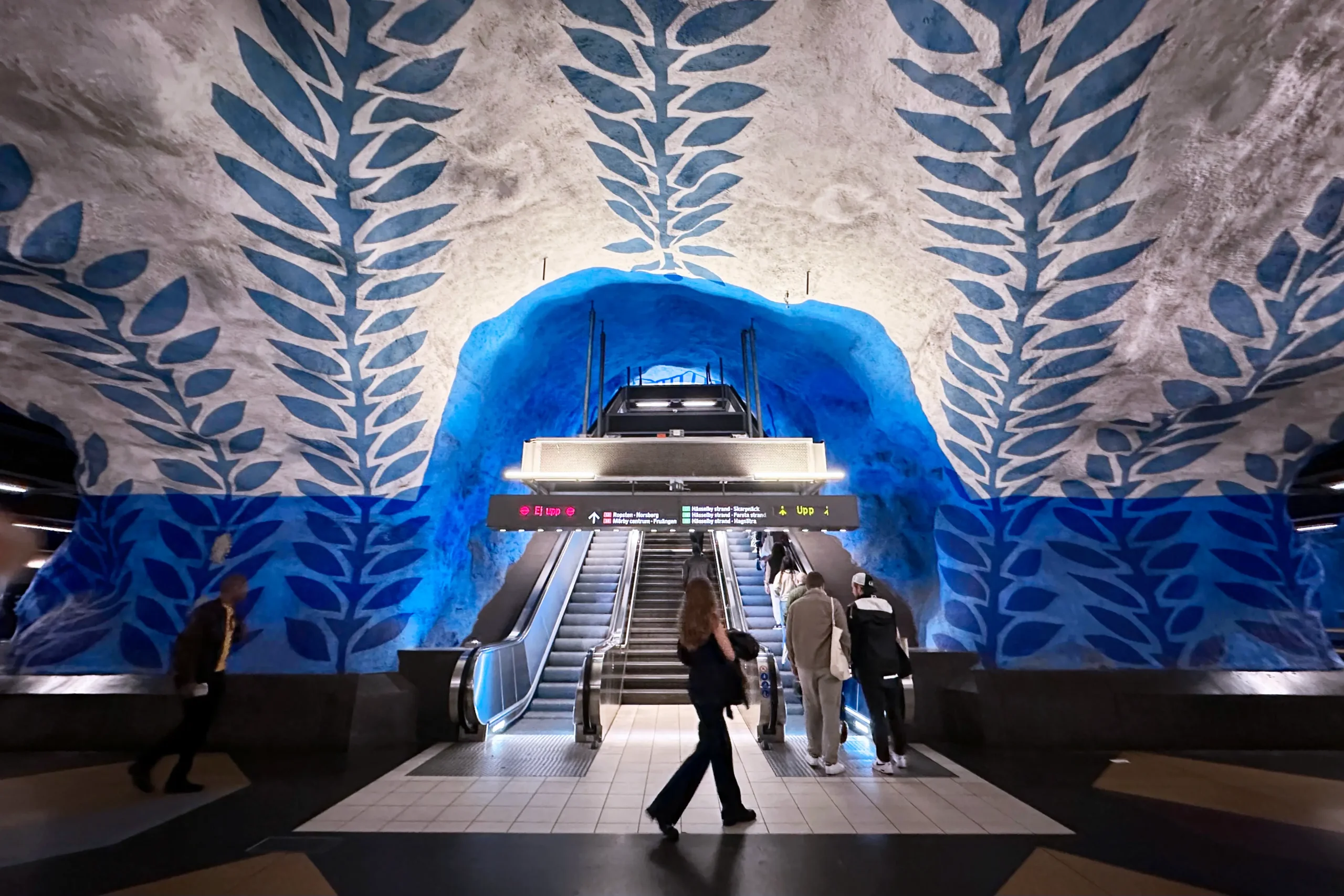
The heartbeat of Stockholm’s metro system. T-Centralen is where it all began—the first station to feature public art. But it’s the Blue Line platform, opened in 1975, that really stayed with me. Painted in soothing shades of blue, with delicate vines and stylized leaves sweeping across the walls and ceilings, it’s a moment of quiet in the rush.
Per Olof Ultvedt, the Finnish-Swedish artist behind it, was known for his kinetic sculptures and collaborations with Jean Tinguely and Niki de Saint Phalle. Here, though, he was after calm. The theory goes that he chose blue not just for its visual appeal but because of its calming effect—perfect for a station where people are rushing, changing trains, making moves. It gives you a pause. A breath.
T-Centralen Station - Art by Per Olof Ultvedt - Photo by Güliz Özbek Collini
Tekniska Högskolan
Opened: 1973
Artist: Lennart Mörk
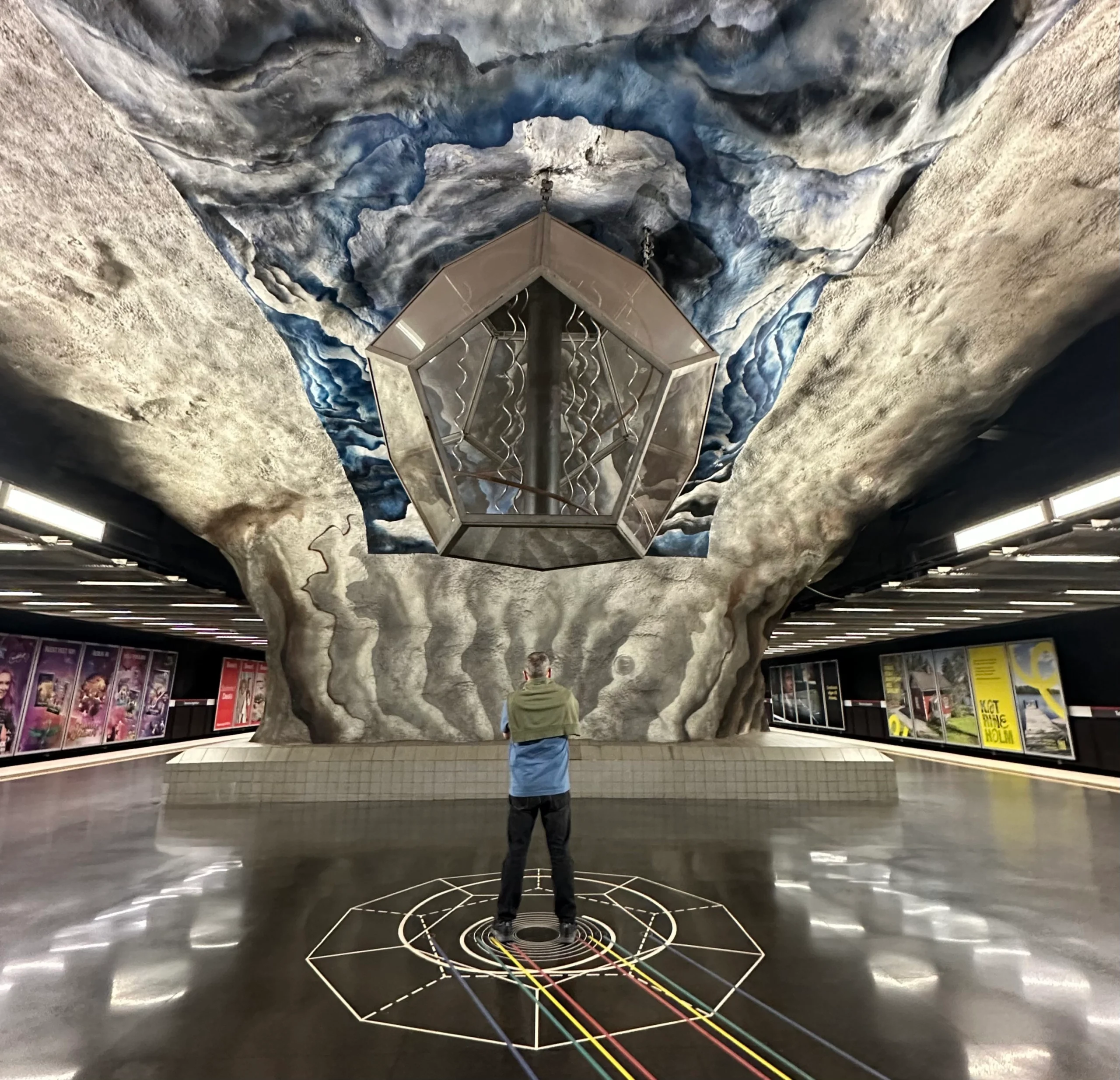
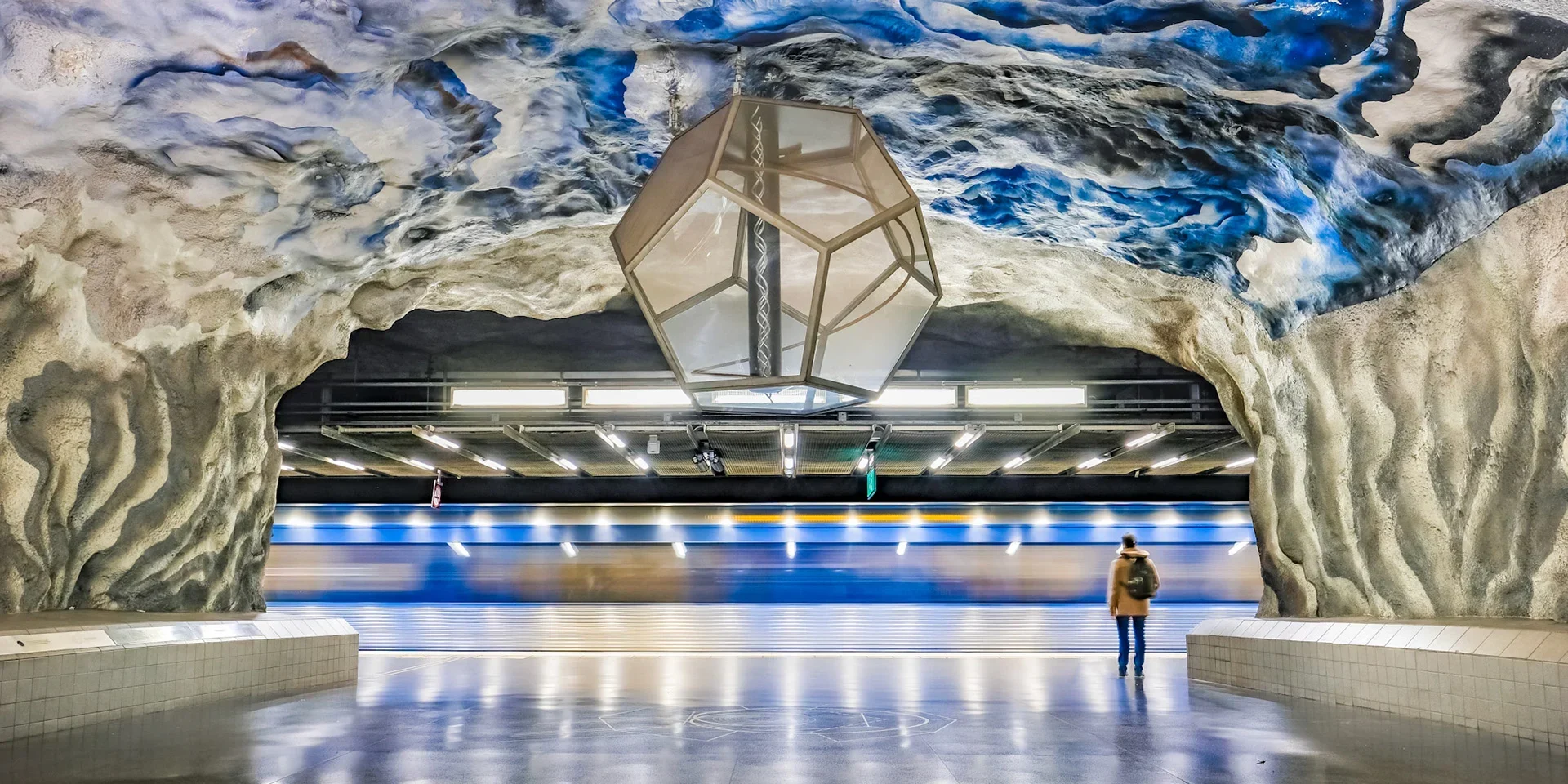
If you’re into science, this one’s for you. Tekniska Högskolan (Royal Institute of Technology) is Stockholm’s main technical university, and the station right beneath it celebrates the spirit of invention.
Lennart Mörk filled the platform with visual nods to scientific history: Copernicus’s heliocentrism, Newton’s laws of motion, da Vinci’s flying machines, and Polhem’s mechanical alphabet. Most striking? The five giant Platonic solids hanging overhead—each symbolizing an element: fire, water, air, earth, and ether. It’s part physics lab, part cathedral.
Teknikse Högskolan Station - Art by Lennart Mörk - Photo by Güliz Özbek Collini
Stadion
Opened: 1973
Artists: Åke Pallarp and Enno Hallek
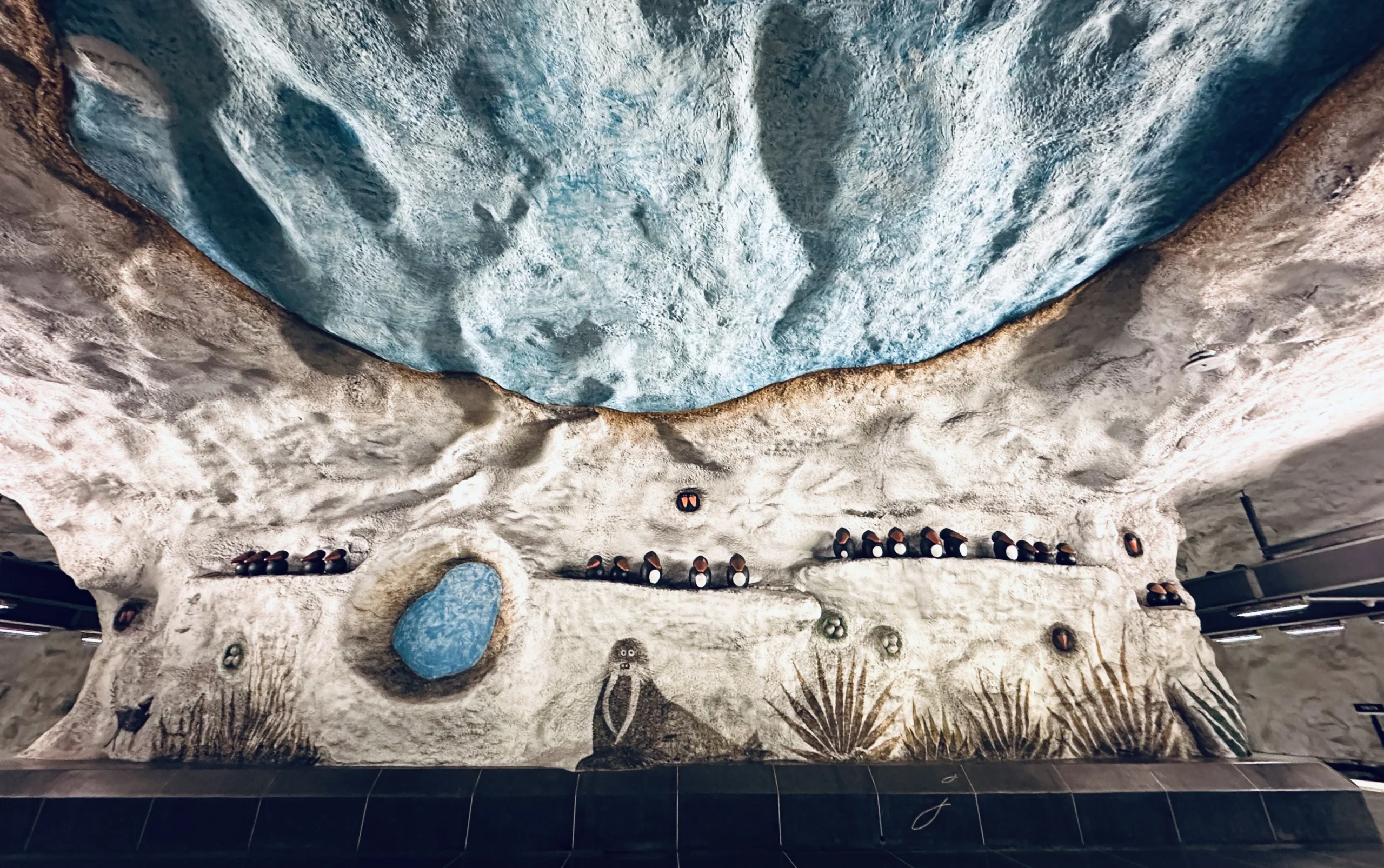
Stadion was one of Stockholm’s first “cave stations,” and at the time, people were weirded out by the idea. Underground spaces = creepy. So to make it feel lighter—both literally and emotionally—the artists painted a giant rainbow across a bright blue ceiling.
The nearby Östermalms IP sports ground is the heart of Stockholm Pride every year, and even though the rainbow wasn’t made specifically for Pride, it now feels like a perfect welcome. The rainbow lifts the whole space—and reminds you that just above this tunnel is the sky, the city, and the Olympic Stadium (where the 1912 Olympics took place, by the way). There’s history in these colors.
Stadion Station - Art by Åke Pallarp & Enno Hallek - Photo by Güliz Özbek Collini
Kungsträdgården
Opened: 1977
Artists: Ulrik Samuelson
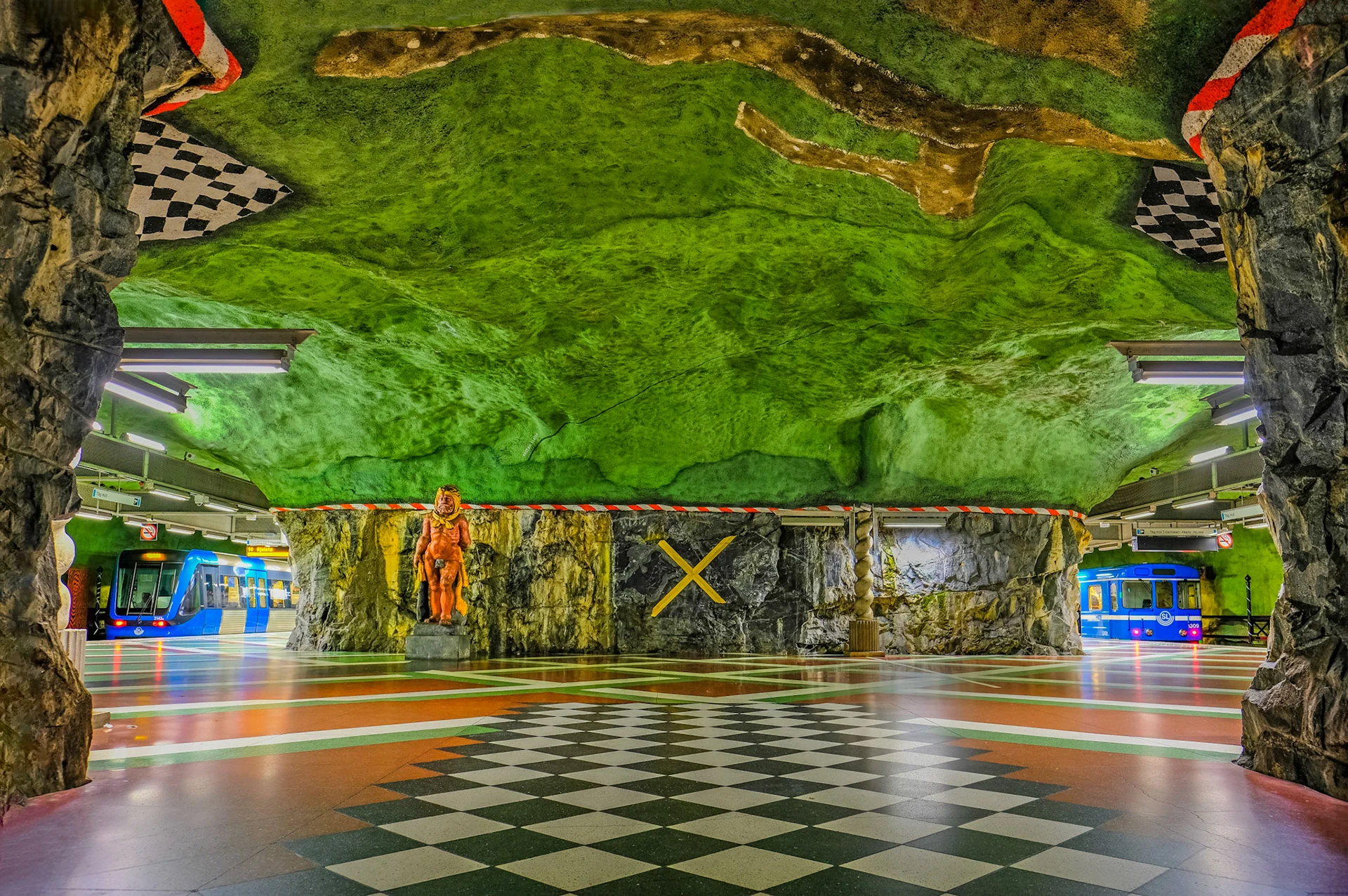
Kungsträdgården might be the most theatrical of all the stations. And no wonder—it sits beneath one of Stockholm’s oldest public parks, a site with a long royal history. The colors—green, white, and red—echo the formal French gardens that once grew above. Sculptures here are actually replicas of the Makalös Palace’s exterior art, which once stood on the same site before it burned down.
Even the biodiversity is special: Kungsträdgården is the only place in Northern Europe where the cave-dwelling spider Lessertia dentichelis lives, probably transported in construction equipment from Southern Europe. An unexpected guest in this dramatic underground world.
Kungsträdgården Station - Art by Ulrik Samuelson - Photo by Dominik Gehl
Solna Strand
Opened: 1985
Artists: Takashi Naraha
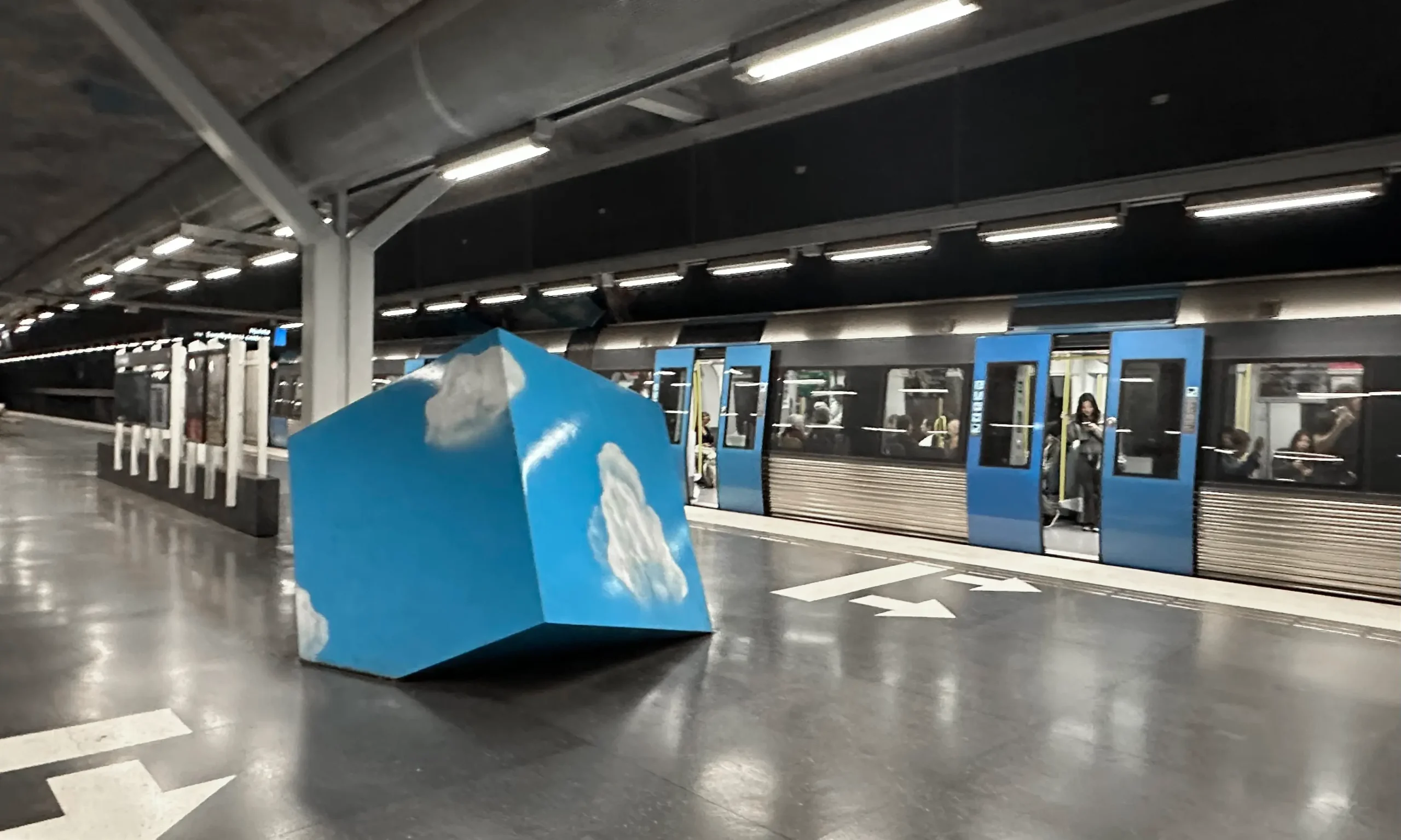
There’s a kind of meditative stillness at Solna Strand. Blocks of white “heavenly cubes” appear to float above the dark cave walls—Takashi Naraha’s signature touch. Naraha, a Japanese sculptor, often worked with the concept of yin and yang, and this station plays with that duality.
The light cubes connect you to the sky outside, while a single dark cube outside the station mirrors the shadowy quiet below ground. The whole thing feels like a quiet philosophical poem—an architectural haiku.
Solna Strand Station - Takashi Naraha - Photo by Güliz Özbek Collini
Solna Centrum
Opened: 1975
Artists: Karl-Olov Björk and Anders Åberg
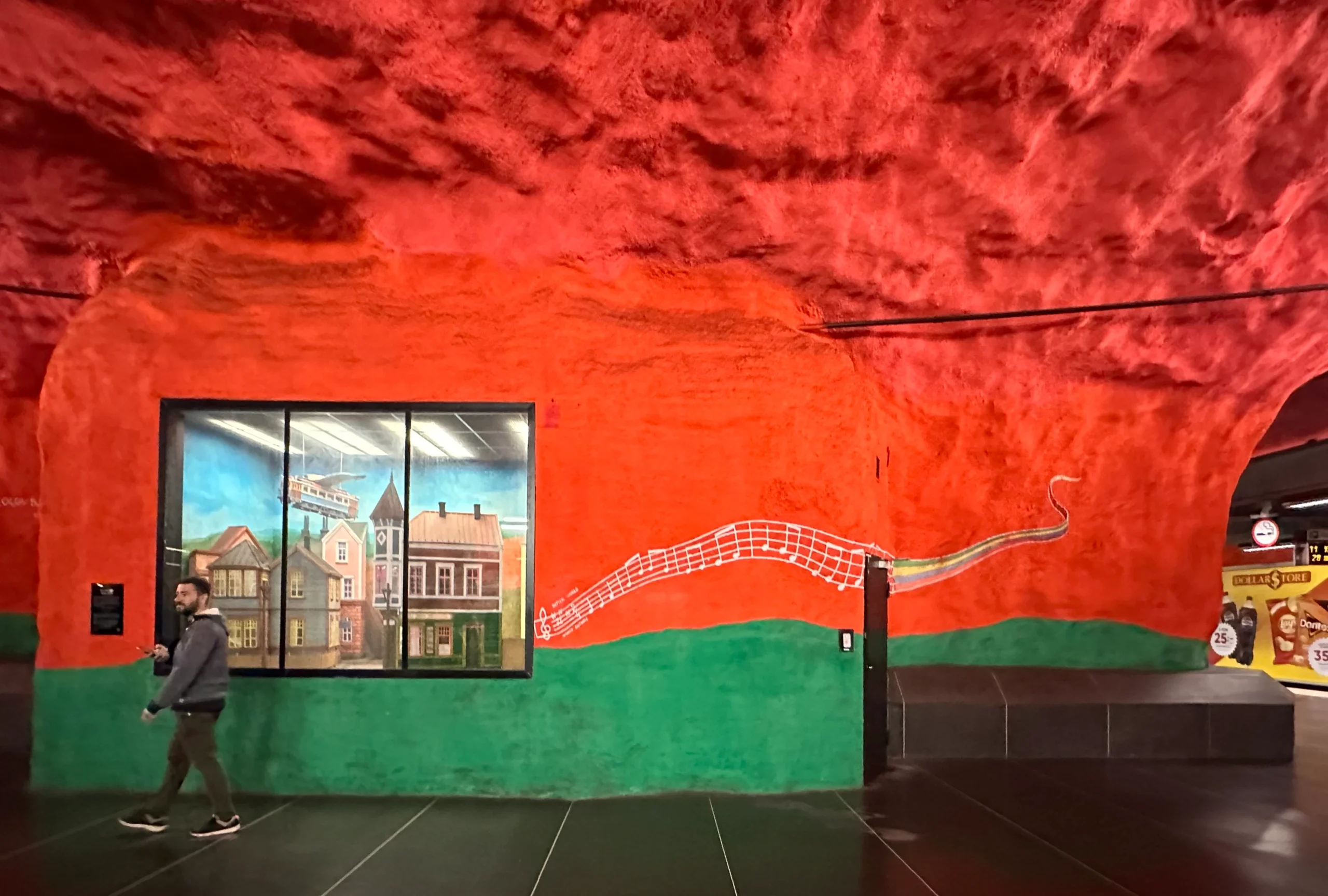
Stepping into Solna Centrum is like walking into a dramatic Nordic painting. The ceiling glows in deep, sunset red; the walls are drenched in pine-forest green. The colors represent a stylized Swedish landscape: dense woods with a fiery sun dipping behind the trees.
Originally, Björk and Åberg created just the sweeping colors. But something felt missing—so they went back and filled the walls with scenes and symbols reflecting hot-button issues of the 1970s: deforestation, environmental destruction, and the exodus from Sweden’s rural areas. This station doesn’t just look stunning—it has a voice.
Solna Centrum Station - Art by Karl-Olov Björk & Anders Åberg - Photo by Güliz Özbek Collini
Tensta
Opened: 1975
Artists: Helga Henschen, Arne Sedell, and Lars Henschen
Tensta is one of Stockholm’s most culturally diverse suburbs, and the artists leaned into that when designing the station. The result? A joyful, white-walled space filled with playful ceramic animals, leafy motifs, and big-hearted words like “Solidarity”, “Kinship”, and “A rose for the immigrants.”
Helga Henschen wanted the space to feel welcoming—like a home for everyone, regardless of background. And it does. It’s gentle, warm, and full of hope. You can feel the intention behind every stroke.
Tensta Station - Art by Helga Henschen, Arne Sedell, Lars Henschen - Photo by Güliz Özbek Collini
Mörby Centrum
Opened: 1978
Artists: Gösta Wessel and Karin Ek
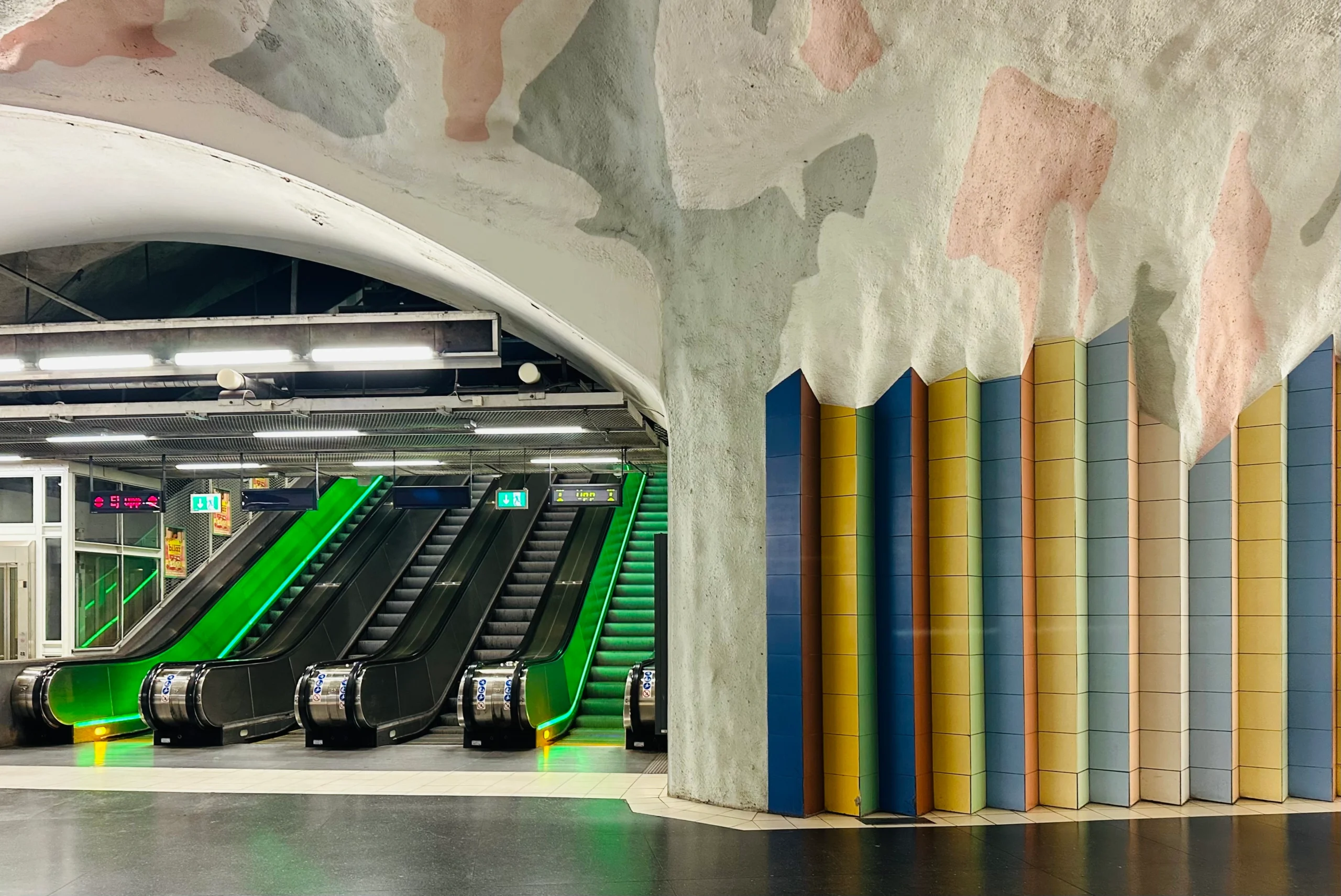
This one plays tricks on your eyes. The walls seem soft and simple—pink and white from one end of the platform, gray-green and white from the other. But it’s not just paint—it’s an optical illusion created by lighting and shadow.
Wessel and Ek painted the wall’s shadows from opposite directions, so the color shifts as you move. It’s subtle, and you might miss it if you’re rushing—but it’s meant to reflect the changing nature of a journey. Everything looks different, depending on where you’re coming from—and where you’re going.
Mörby Centrum Station - Art by Gösta Wessel & Karin Ek - Photo by Güliz Özbek Collini
Rådhuset
Opened: 1975
Artists: Sigvard Olsson
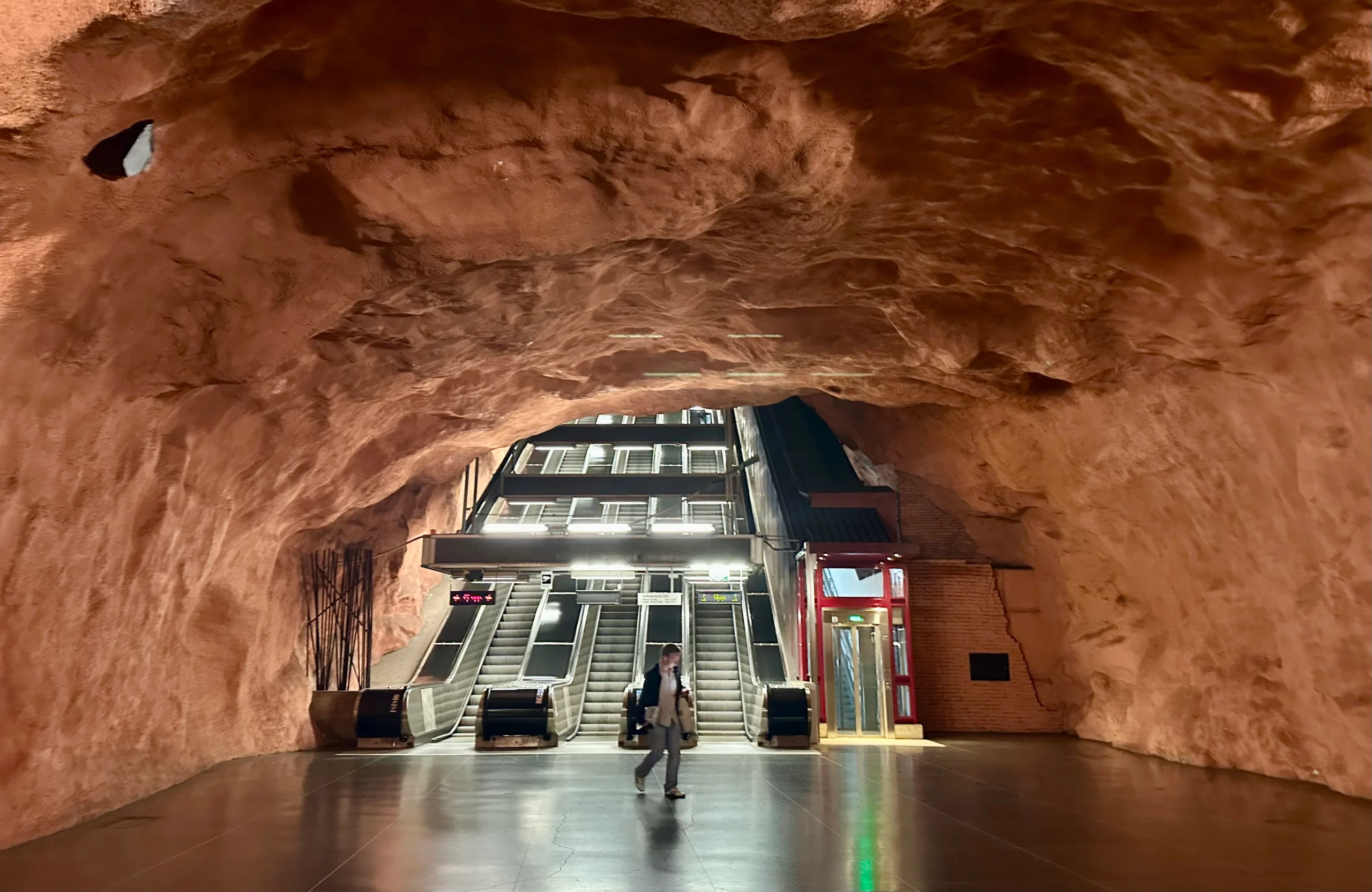
This station is like walking into an archaeological dig. Located on Kungsholmen island, beneath the Stockholm Courthouse, Rådhuset is washed in dusty pink—echoing the colors of the Atlas Mountains, where artist Sigvard Olsson once traveled.
Olsson was deeply inspired by abstract expressionism, and here he wanted to create a sense of buried history—like you’re seeing remnants of things that once were. Look closely and you’ll notice traces of old Kungsholmen: fragments, fossils, stories lost to time but rising now from the earth.
Rådhuset Station - Art by Sigvard Olsson - Photo by Güliz Özbek Collini
Akalla
Opened: 1977
Artists: Birgit Ståhl-Nyberg
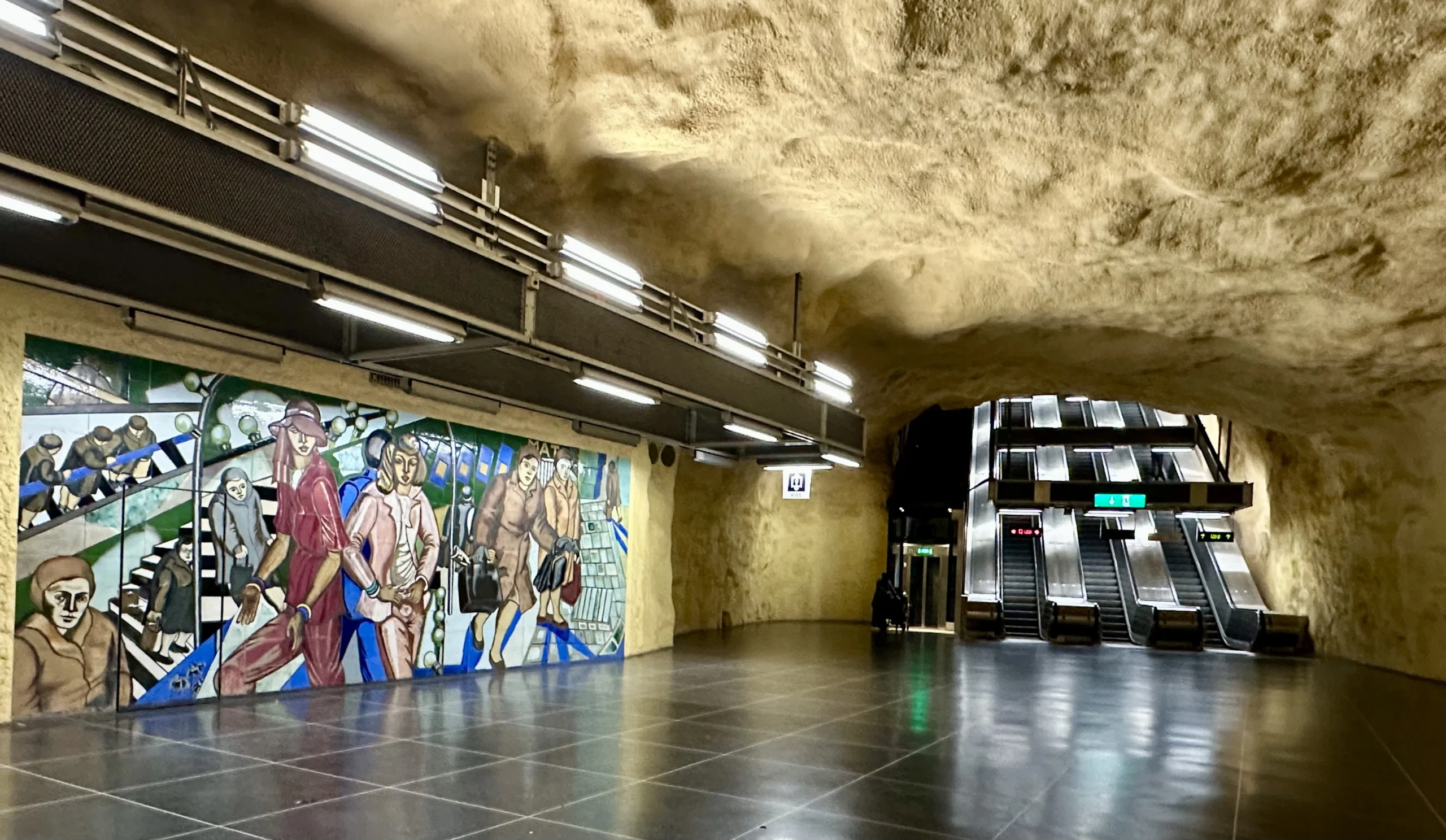
Akalla is drenched in ochre, and its ceramic panels glow with images of everyday life—workers, families, leisure, community. Created in 1977 by Birgit Ståhl-Nyberg, the work reflects the social ideals of the era.
Ståhl-Nyberg was known for her political edge, and here she brings those values underground—celebrating the dignity of daily life. Her work, influenced by French Cubist Fernand Léger, feels strong and grounded.
Akalla Station - Art by Birgit StåhlNyberg - Photo by Güliz Özbek Collini