


Forever Is Now returns for its sixth edition from 8 to 28 November 2026 at the iconic Pyramids of Giza. Organised by Art D’Égypte, the international exhibition brings together contemporary artists from different cultural backgrounds to engage with one of humanity’s most extraordinary cultural landmarks.
Set against the backdrop of the Pyramids of Giza, Forever Is Now invites artists to contemplate the wonder of ancient civilisation through the lens of contemporary artistic practice. This year’s participating artists present distinct perspectives and disciplines, creating a dialogue between the site’s ancient heritage and contemporary artistic expression.
Addressing guests at the opening, Nadine Abdel Ghaffar, Founder of Art D’Égypte by CulturVator, reflected on the significance of the sixth edition and the organisation’s tenth anniversary. She reaffirmed the platform’s belief in international artistic dialogue, wider access to art and the lasting value of cultural and community engagement.
“This year holds a particularly special meaning for us, as we celebrate Art D’Égypte’s tenth year,” she said. “Ten years ago, we had a dream. We wanted the world to see Egypt not only for the extraordinary history we inherited, but for the creativity we continue to produce today.”
“We have always believed that the true value of art lies not only in what it creates, but also in the people it reaches and the opportunities it inspires. That is why our commitment extends far beyond exhibitions. Through educational initiatives and community engagement programmes, we continue to open doors for young people, nurture creative talent and encourage future generations to discover, appreciate and protect Egypt’s cultural heritage.”
This year’s edition features 8 artists from Turkish, Saudi, French, American, Chinese, British-Jamaican and Egyptian backgrounds, each bringing a distinct artistic language and perspective to the site:
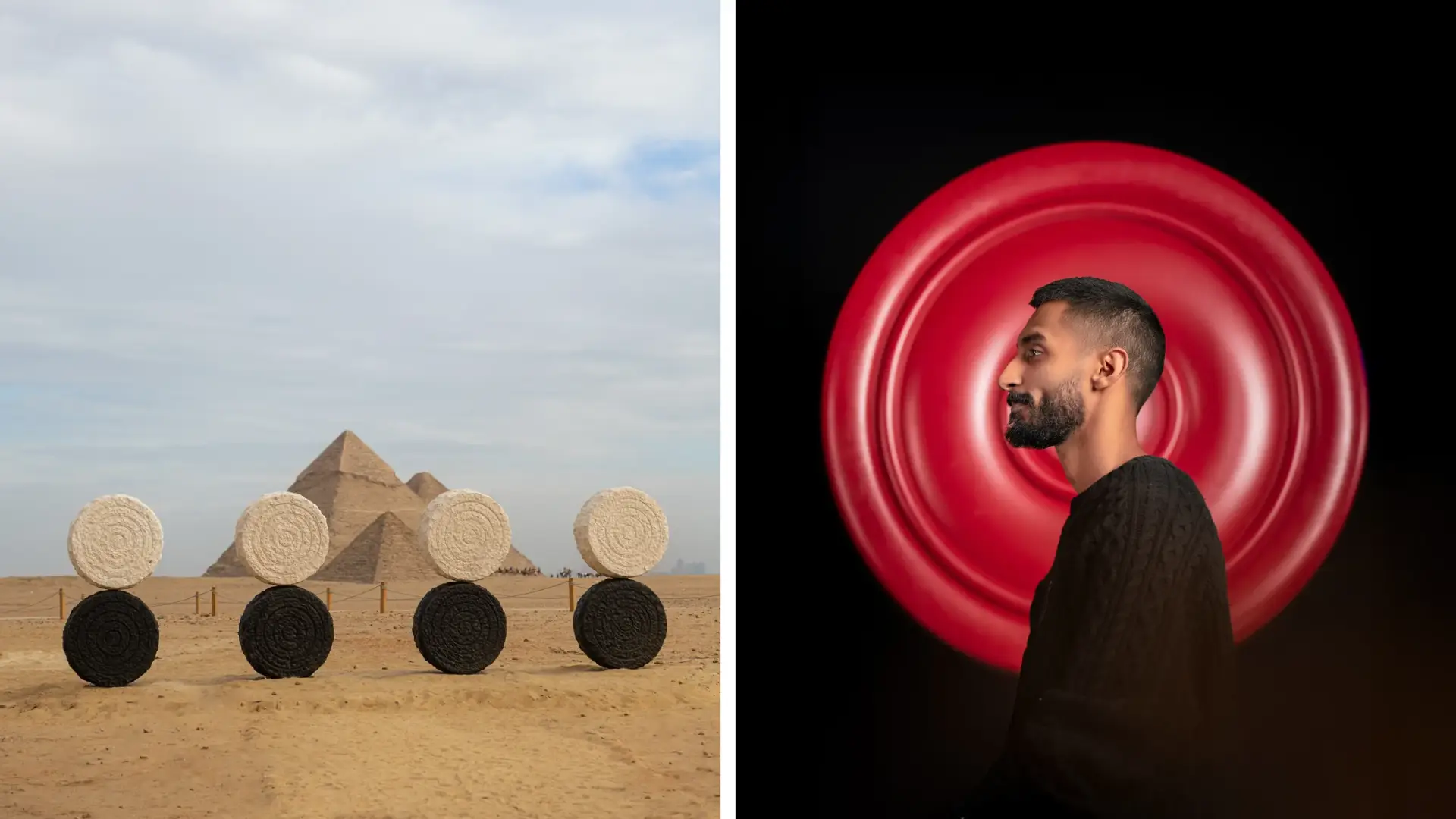
Abdul Rahman Taha — The Gathering
Saudi contemporary artist Abdul Rahman Taha approaches architecture and urban space as living archives, examining how places preserve collective memory and how cultural practices pass between generations. Working across installation, sculpture and photography, his practice often explores the relationships among people, their surroundings and the traditions embedded in everyday life.
For The Gathering, Taha takes inspiration from tawla, or backgammon, a board game that has long brought friends and families together across Egypt. He enlarges the familiar playing pieces into monumental stacked forms, translating an everyday object of social connection into carved stone. Concentric rings drawn from the original pieces are cut into each face, their precise geometry set against irregular edges. The work reflects the balance between shared rules and the unpredictability of the people who play.
Rather than depicting players, Taha considers the game as a social system through which people learn to wait, negotiate, compete, cooperate and belong. Its knowledge is passed on through practice and repetition, without the need for written instruction. Positioned beside the pyramids, the stacked forms suggest continuity across generations, bringing together the permanence of stone and the living traditions sustained through human interaction.
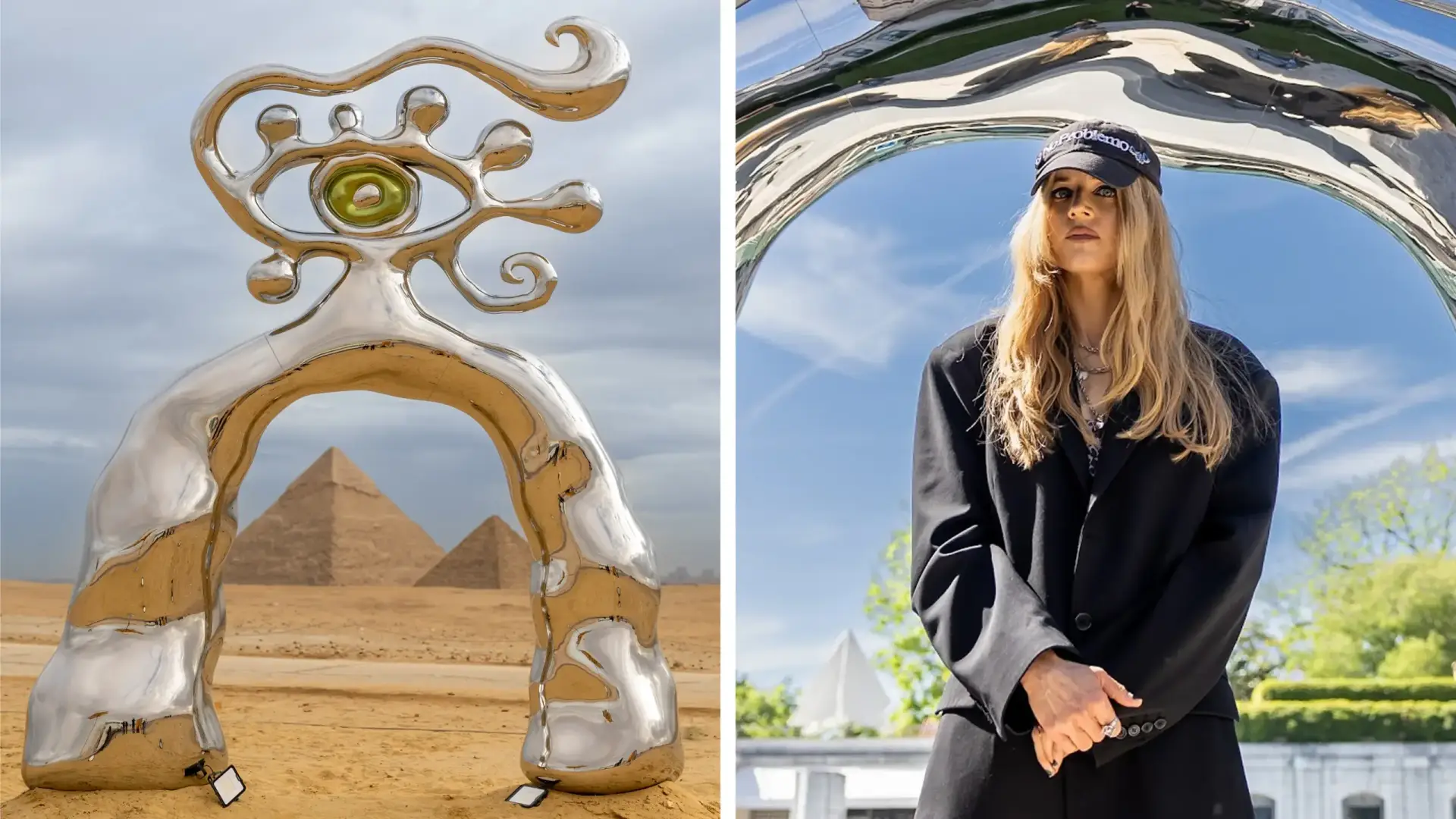
Charlotte Colbert — Possible Landscapes
British-French multimedia artist and award-winning filmmaker Charlotte Colbert explores identity, memory, transformation, dreams and the unconscious. Her work moves between film, sculpture and installation, often drawing on surreal imagery and philosophical ideas to question how people understand themselves and the world around them. Her work has been presented internationally, including at the V&A, Montpellier Contemporain, Frieze and Art Basel.
In Possible Landscapes, Colbert introduces a monumental steel arch crowned by a single eye. Drawing on the symbolism of mythic gateways and thresholds, the sculpture creates a passage between inner and outer worlds. The eye becomes a point of encounter, inviting visitors to consider perception, imagination and the unseen forces that shape reality. The work’s reflective surface also brings the surrounding landscape into its visual field, making the environment part of the experience.
Colbert’s wider practice often blurs the boundaries between reality and fantasy, using surreal forms to open up alternative ways of seeing. At Giza, Possible Landscapes places this approach in dialogue with a site whose own history is shaped by questions of belief, vision and the human imagination.
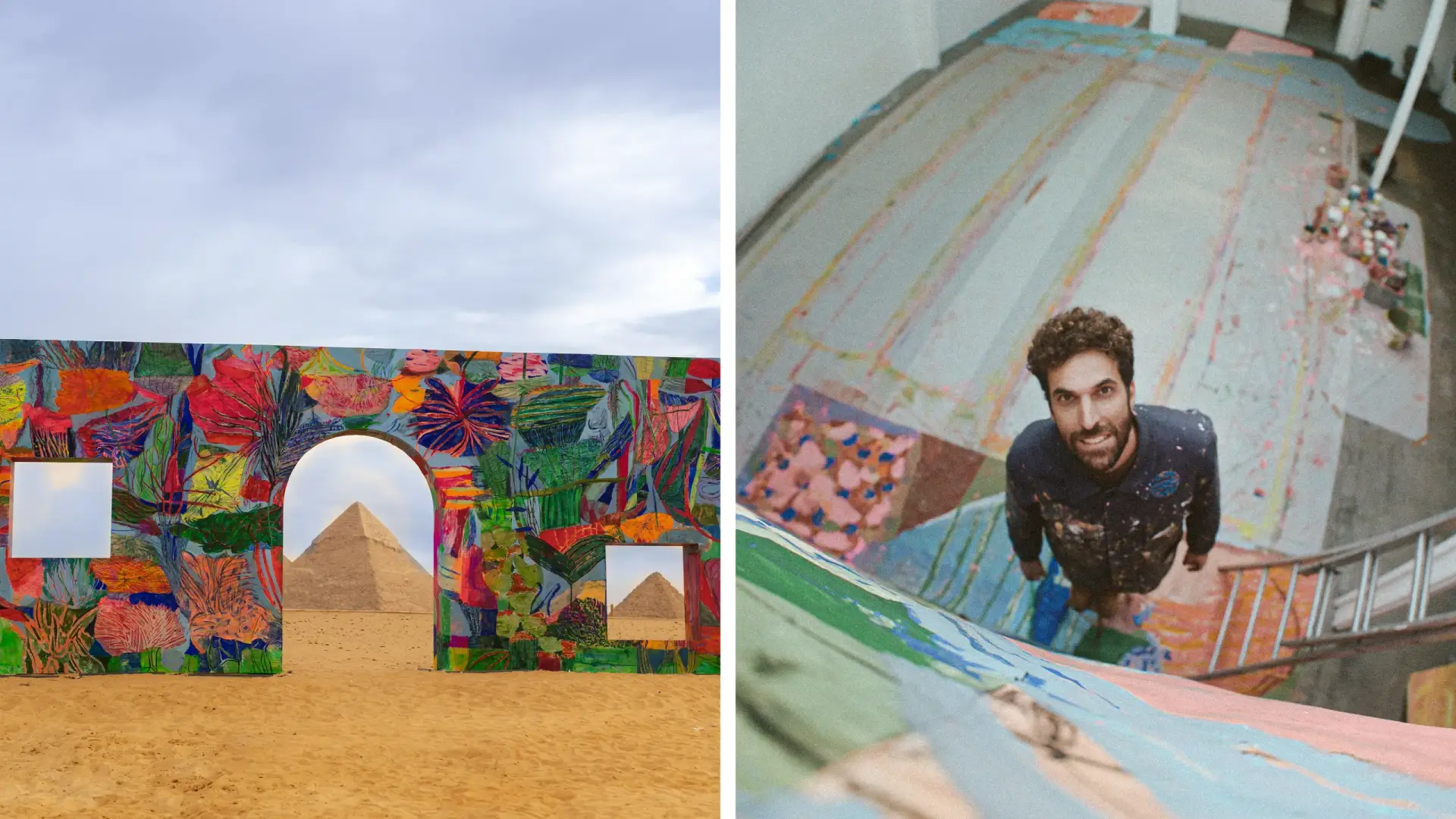
Geoffroy Pithon — Hortus Pictus
French multidisciplinary artist Geoffroy Pithon is known for treating painting as an immersive and spatial experience. Based in Nantes, he develops large-scale installations from painted elements that he cuts, rearranges and recomposes into vibrant environments. His practice draws on the visual rhythms of gardens and natural growth, embracing repetition, chance and transformation.
At Giza, Hortus Pictus takes the form of a painted architecture rising from the desert. Conceived as a garden made through colour, the installation revisits an older understanding of painting in which representations of nature do not simply decorate architecture but extend its space, creating an environment to inhabit and move through.
Rather than offering a botanical illustration, Pithon’s work seeks to evoke the forces and energies that animate the living world. Its vivid surfaces establish a contrast between fertility and aridity, colour and stone, garden and desert. The openings frame fragments of the Giza landscape, drawing the pyramids into the composition and turning the surrounding environment into part of the artwork. The installation becomes a threshold between the physical landscape and an imagined world shaped by colour and movement.
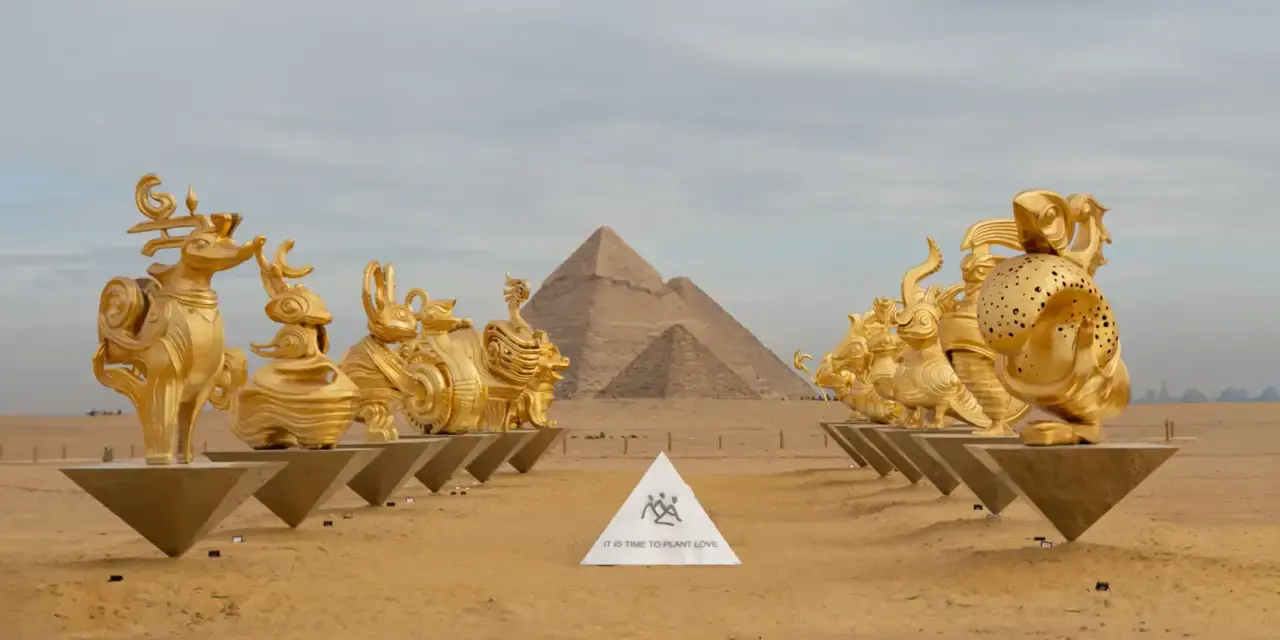
Jiang Qiong Er — It Is Time to Plant Love
Internationally acclaimed Chinese artist and designer Jiang Qiong Er works across painting, sculpture, installation, video and public art. Rooted in Chinese philosophy and shaped by her experience across cultures, her practice explores memory, time and the shared spiritual heritage of humanity. She describes her approach through the idea of “Universal Art”: a visual language intended to reconnect people with history, nature and one another.
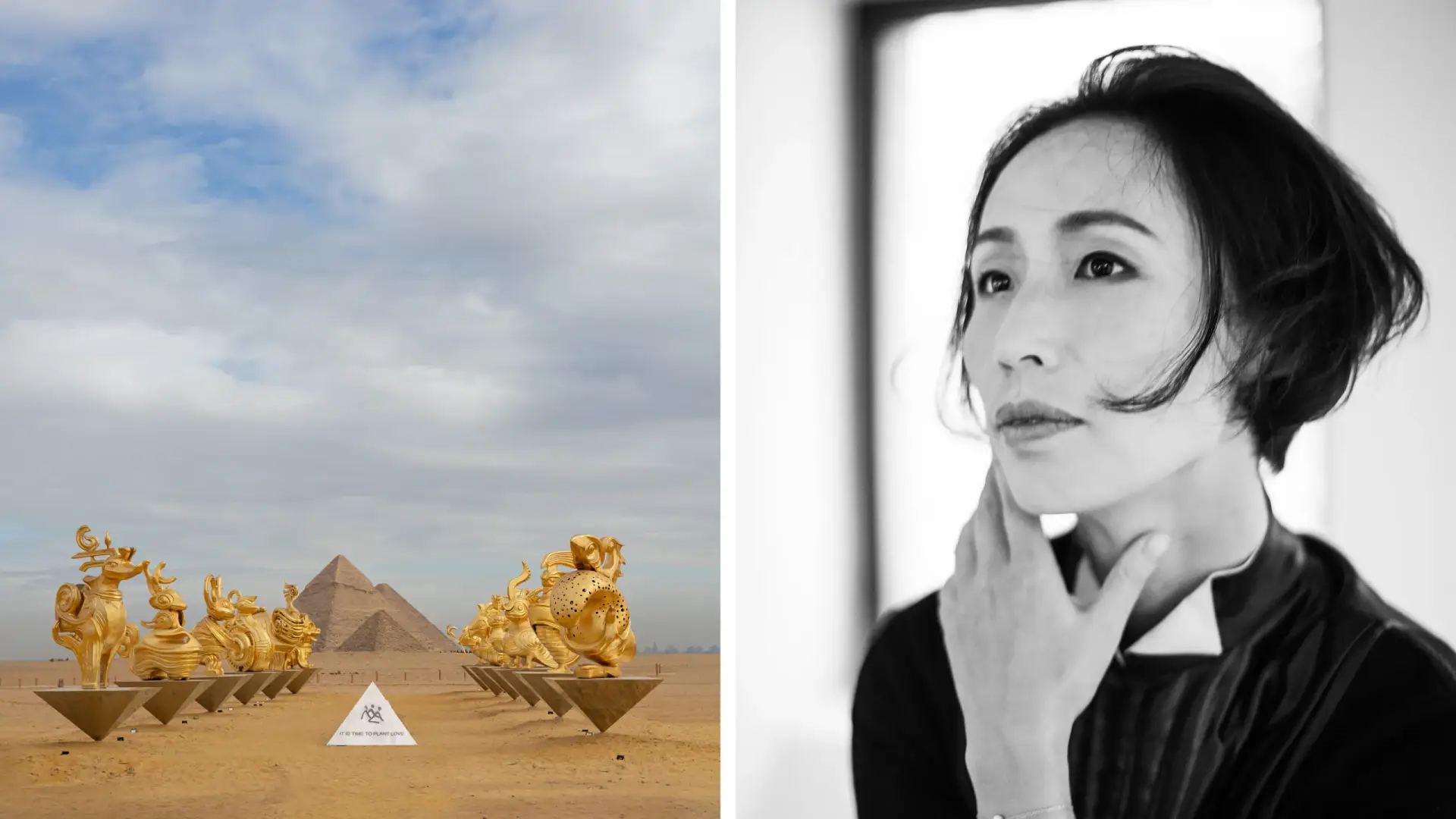
It Is Time to Plant Love brings together the Twelve Guardians, the Path of Guardians and a new hieroglyph for “Love”, conceived by the artist for the twenty-first century. Drawing on sacred creatures and mythologies from ancient civilisations, the twelve figures embody shared human values: Exploration, Freedom, Inclusion, Time, Authenticity, Peace, Nature, Benevolence, Wisdom, Fraternity, Bravery and Equality.
Together, the figures form a reflective passage in which the sky, the pyramids and the surrounding landscape meet the reflections of visitors. As people move between the guardians, they are invited to consider the values humanity has inherited, those it must protect and those it hopes to carry forward. The installation creates a meeting point between different cultural histories, suggesting that a shared sense of humanity can exist beyond distinctions of geography, language and time.
Raphaele Shirley — Passage
French-American multimedia artist Raphaele Shirley works across sculpture, light, sound, video and performance, often developing site-specific installations in collaboration with specialists from different disciplines. Drawing on science, ecology and cosmology, her practice examines how the universe and human existence have been understood across time, from religious and metaphysical traditions to contemporary scientific inquiry.
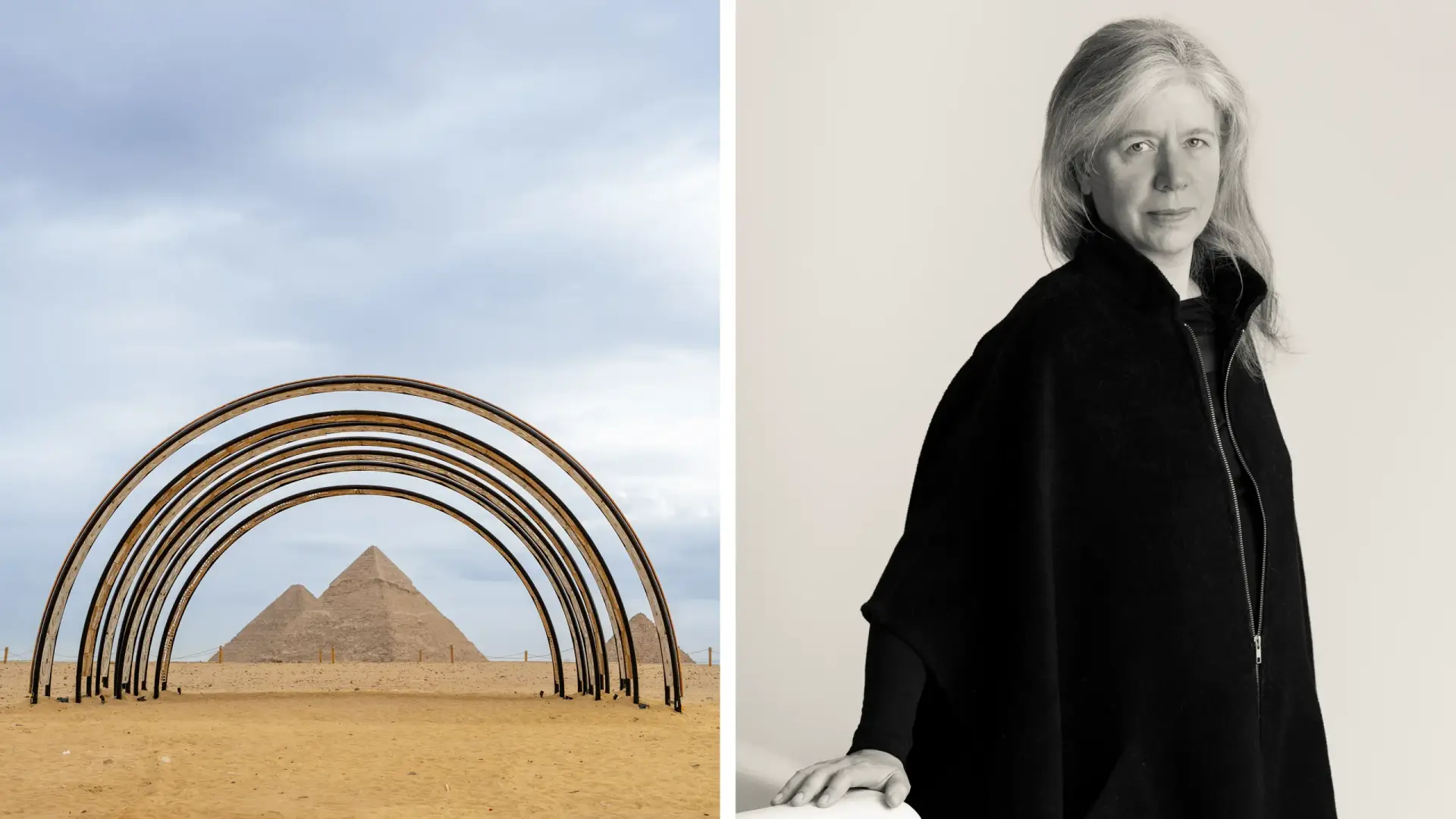
Her installation Passage is composed of expanding concentric rings made from woven palm reed, copper, steel and light. Visitors move through this permeable structure, experiencing the work as both an architectural form and a passage through space. Its concept draws on the ancient Egyptian understandings of neheh, or cyclical time, and djet, or enduring time, exploring transformation as part of an ongoing continuum.
The arcing forms also recall akhet, the hieroglyph for the horizon depicting the sun rising between two peaks, and Nut, the goddess of the sky, whose curved body spans the earth. As sunlight changes throughout the day, the rings cast shifting shadows across the ground, extending the sculpture beyond its physical structure. Produced and handmade in Egypt, Passage brings together material, light and movement to suggest the coexistence of permanence and impermanence.
Rochelle-Webster Nembhard — Celestial Vessels
British-Jamaican interdisciplinary artist Rochelle-Webster Nembhard is based between South Africa and Oaxaca, Mexico. Working across performance and sculpture, her practice explores rematriation, generational healing, decolonisation and the relationship between people and the natural world. She approaches land and natural materials as carriers of knowledge, identity and ancestral memory, often working with earth, clay, stone and natural pigments.
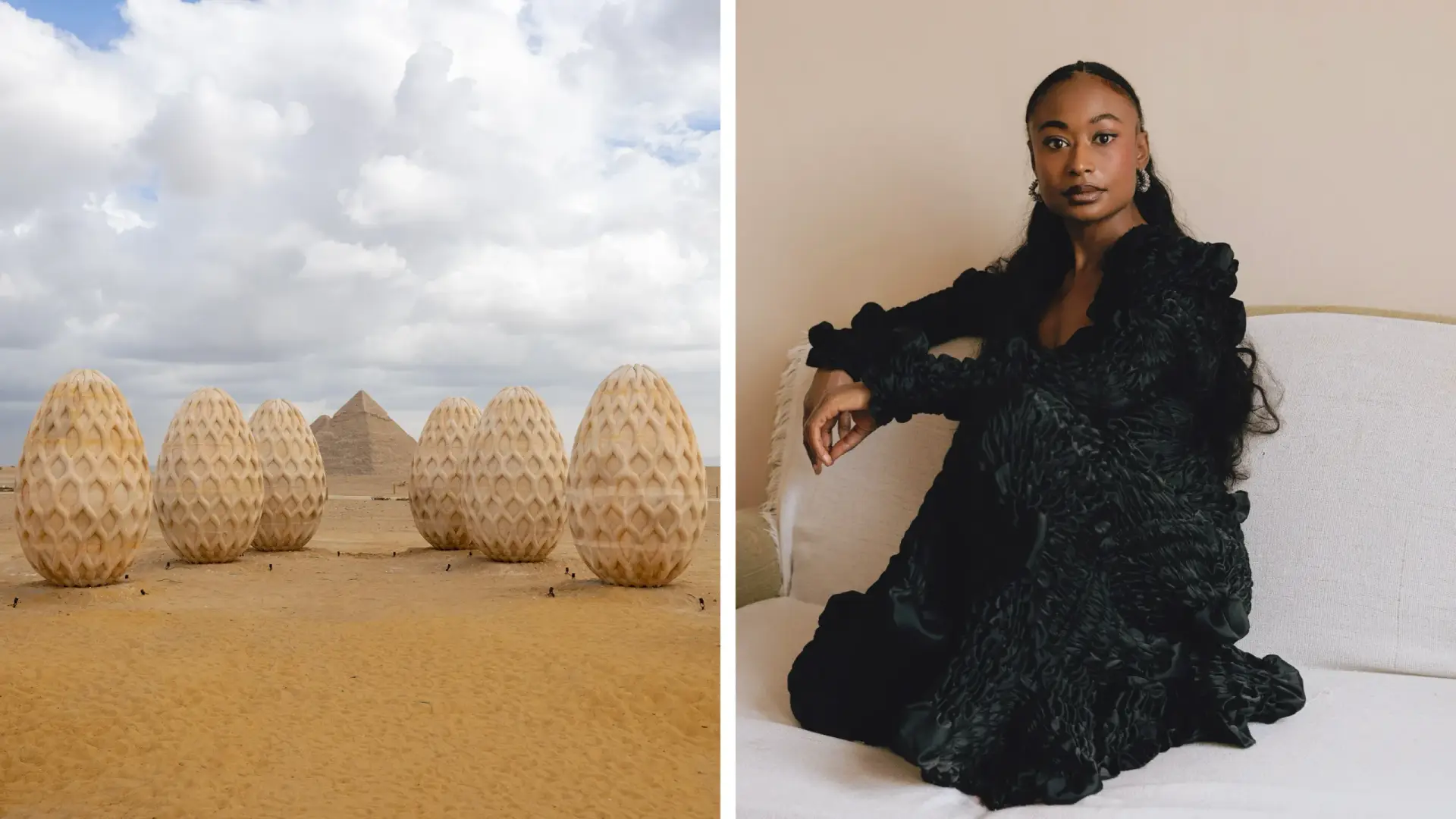
For Celestial Vessels, Nembhard draws on the ancient Egyptian Hermopolitan creation narrative and the Ogdoad: the eight primordial forces associated with the moment before the emergence of first light. The installation presents eight monumental vessels arranged across the plateau like a constellation. Their forms enter into dialogue with the pyramids through two complementary geometries: the pyramid, associated with ascent, achievement and human potential, and the egg, representing origin, protection and possibility.
The work considers what humanity may become, proposing that progress cannot be measured only through technological or monumental achievement. It also depends on the ability to return to the earth, recognise interdependence and renew our relationship with the living world. In this way, the vessels offer a reflection on both human aspiration and the responsibility to care for the natural environment.
Seçkin Pirim — The King’s Road
Turkish sculptor Seçkin Pirim, who lives and works between Istanbul and London, is known for a neo-minimalist practice shaped by repetition, transformation and the search for inner movement. Working with materials including plexiglass, paper, marble and aluminium, he creates layered forms that explore renewal, self-realisation and the relationship between the individual and the whole.
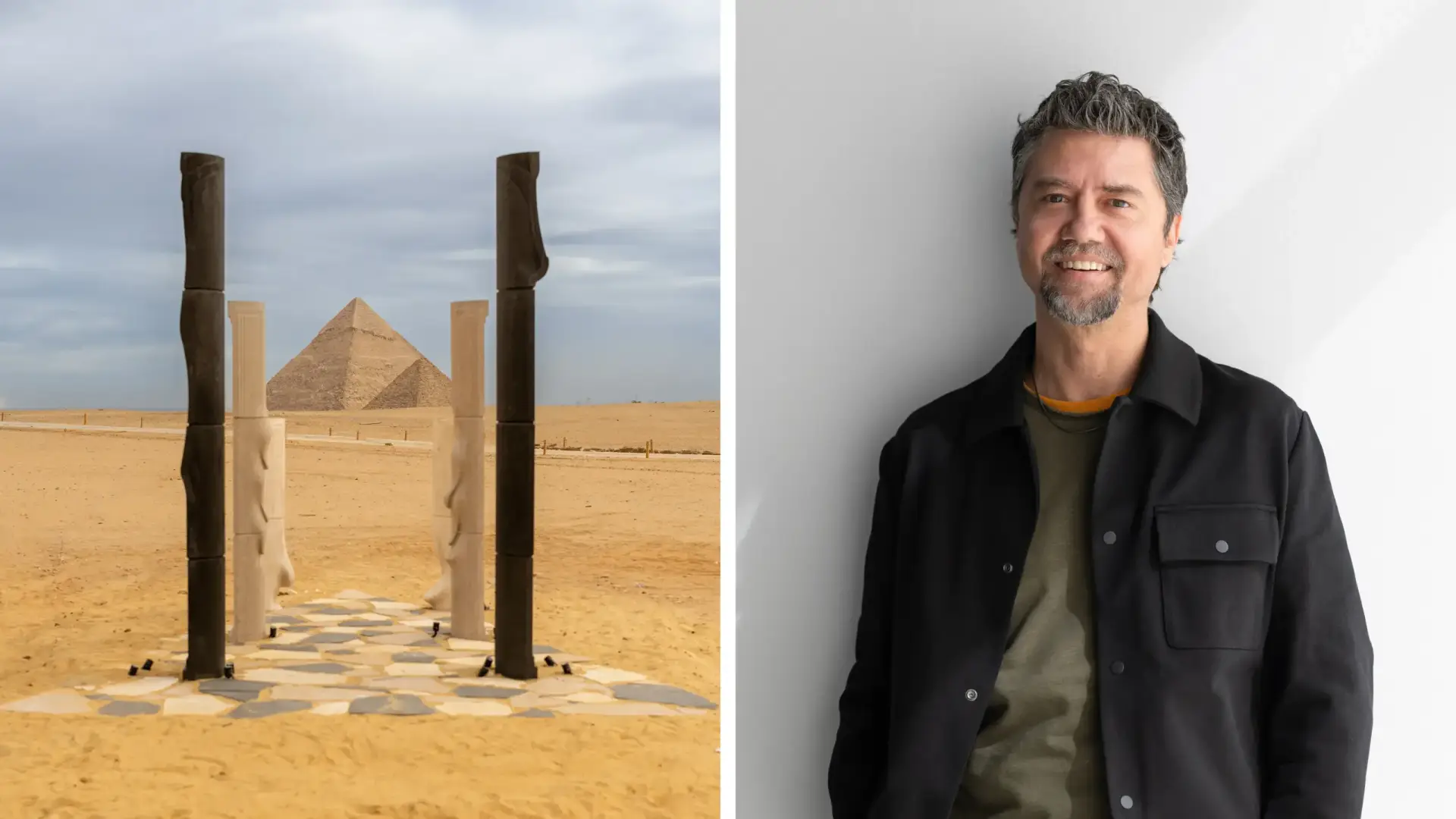
With The King’s Road, Pirim draws on the historical routes that connected quarries and temples across the Giza Plateau, linking stone, memory and movement. Developed with the curatorial direction of Ayça Okay, the installation uses columns of Egyptian marble to transform the idea of a road into a sculptural experience. Their repeated forms establish a route through the landscape, inviting visitors to move between them rather than simply observe them as a static monument.
Light and shadow are central to the work. As the sun moves across the plateau, shadows lengthen and shift, changing the installation’s appearance throughout the day. The varying heights and eroded surfaces of the marble forms hold traces of time, while their repetition creates a sense of rhythm and orientation. The work brings together stone, the moving body and the history of the site in a shared passage.
Emad Abu Grain — Talisman of Salvation
Representing Egypt, visual artist and painter Emad Abu Grain was born in Assiut, Upper Egypt. His work for Forever Is Now 06 draws on the symbolic and spiritual language of ancient Egyptian belief, turning to the Book of the Dead and its reflections on the journey towards eternity.
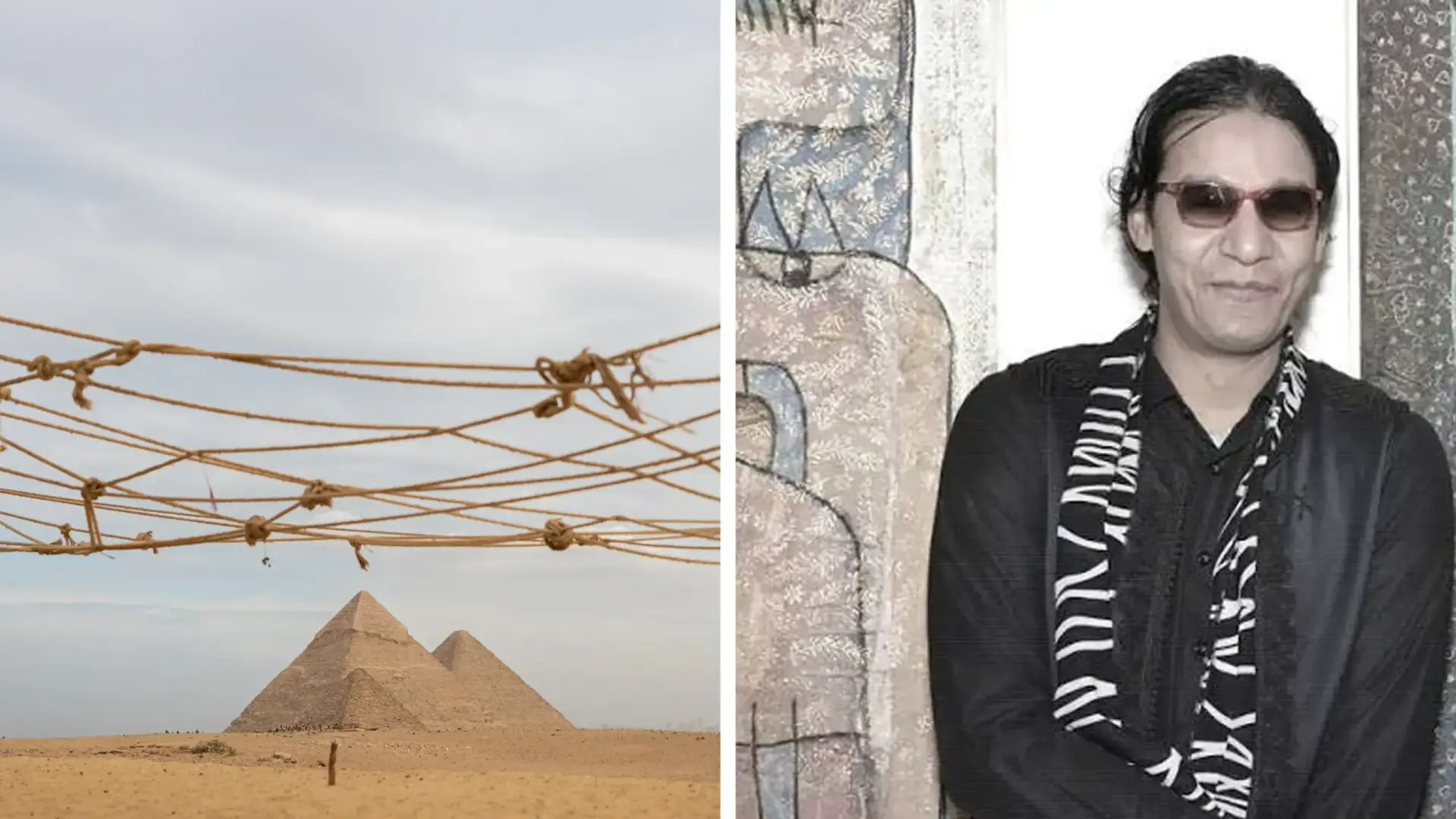
In Talisman of Salvation, Abu Grain explores the relationship between awareness and heedlessness, and the moral knowledge required to move towards salvation. Using stone and rope, he creates a sculptural composition that considers how what appears heavy or restrictive might be transformed into a passage towards light. The work evokes the journey of the soul and the importance of wisdom and moral purity within it.
Set against the pyramids, the installation connects contemporary artistic expression with ancient ideas of passage, judgement and the afterlife. Its materials and symbolism invite visitors to reflect on the choices and values that shape the human journey.
Cover Image: Jiang Qiong Er – It Is Time to Plant Love (2026), stainless steel, fibreglass and gold leaf; Twelve Guardians: 12 pieces, each 2 × 2 × 3.6 m; Path: 2 × 1.3 × 21 m.